
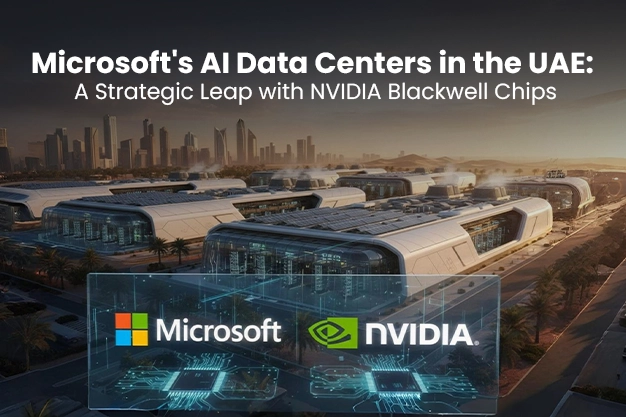
Microsoft’s AI Data Centers in the UAE: A Strategic Leap with NVIDIA Blackwell Chips
Microsoft has announced an ambitious plan to build cutting-edge AI data centers in the United Arab Emirates, powered by NVIDIA‘s revolutionary Blackwell chips. This strategic initiative represents more than infrastructure expansion—it’s a transformative investment that positions the UAE as a major player in the global AI revolution while reshaping the Middle East’s technological landscape. The UAE’s Digital Ambitions Meet Global Tech Innovation The UAE has consistently pursued its vision of becoming a global technology leader. The country’s Vision 2031 outlines ambitious goals for a knowledge-based economy driven by smart cities, digital government services, and world-class research institutions. Microsoft’s investment directly supports these national priorities by bringing state-of-the-art AI infrastructure to the region. This partnership arrives at a critical moment when Middle Eastern nations are competing to attract technology investments and position themselves as innovation hubs. By establishing advanced AI capabilities locally, the UAE gains several strategic advantages: Strategic Advantages for the UAE Strategic Benefit Impact Regional Leadership Positions UAE alongside global tech hubs in the U.S., Europe, and Asia Economic Diversification Reduces oil dependency through high-tech job creation and investment attraction Data Sovereignty Enables organizations to comply with local data residency requirements Innovation Ecosystem Attracts startups, research institutions, and multinational tech operations National Competitiveness Accelerates AI adoption across energy, healthcare, logistics, and government NVIDIA Blackwell: The Engine of Next-Generation AI At the core of these data centers lies NVIDIA’s Blackwell chip architecture—a groundbreaking advancement designed specifically for the demands of modern artificial intelligence. These chips represent a quantum leap in computing capability, purpose-built to handle the massive computational requirements of training large language models, generative AI systems, and real-time inference at scale. Blackwell Chip Advantages Feature Capability Real-World Application Processing Power Unprecedented performance for training massive AI models Faster development of GPT-class language models and image generators Energy Efficiency Maximum performance per watt consumed Reduced operational costs and environmental impact AI-Optimized Architecture Purpose-built for machine learning workloads Rapid experimentation, model fine-tuning, and scaling Advanced Memory Systems High-bandwidth memory for data-intensive tasks Real-time processing of video, medical imaging, and sensor data This specialized hardware enables applications that were previously impractical or impossible—from autonomous vehicle systems analyzing sensor data in milliseconds to healthcare platforms diagnosing diseases from medical imaging with superhuman accuracy. What Makes AI Data Centers Different? AI data centers differ fundamentally from traditional cloud facilities. They feature massive clusters of specialized GPUs like NVIDIA’s Blackwell chips, ultra-high-speed networking infrastructure, and sophisticated cooling systems designed to handle extreme computational loads continuously. These facilities enable: Local, Low-Latency Access: Regional businesses and government agencies can deploy AI applications without the delays inherent in connecting to distant data centers, crucial for real-time applications like autonomous systems and live video analysis. Massive Scale Training: Researchers and companies can train cutting-edge AI models on enormous datasets, accelerating innovation in everything from Arabic language processing to climate modeling for desert agriculture. Compliance and Security: Sensitive data remains within national borders, satisfying regulatory requirements while maintaining the security standards that government and enterprise customers demand. The Microsoft–NVIDIA Synergy This partnership leverages the complementary strengths of two technology giants. Microsoft brings its trusted Azure cloud ecosystem, global enterprise relationships, and experience with regulated industries. NVIDIA contributes the world’s most advanced AI hardware and deep expertise in accelerated computing. For UAE businesses, startups, and government agencies, this collaboration delivers: Turnkey AI Infrastructure: Advanced capabilities without the massive capital investment required to build proprietary systems Enterprise-Grade Reliability: Microsoft’s proven track record in security, compliance, and 24/7 support Scalability on Demand: The flexibility to expand or contract computing resources based on project needs Access to Cutting-Edge Innovation: Immediate availability of the latest AI breakthroughs and model architectures Economic and Geopolitical Implications The ripple effects of this investment extend far beyond technology. By establishing world-class AI infrastructure, the UAE attracts international talent, fosters entrepreneurial ecosystems, and creates high-skilled employment opportunities. Multinational corporations gain confidence establishing regional headquarters when sophisticated digital infrastructure exists locally. From Dubai’s fintech startups to Abu Dhabi’s energy sector, from smart city initiatives to advanced healthcare systems, locally accessible AI computing power accelerates innovation across every economic sector. Building the AI-Powered Future Microsoft’s UAE data center initiative, powered by NVIDIA’s Blackwell chips, exemplifies how strategic infrastructure investments can transform national competitiveness in the digital age. As artificial intelligence becomes increasingly central to economic success and quality of life, access to world-class computing power will separate thriving nations from those left behind. The UAE, through visionary leadership and smart partnerships with technology pioneers, is positioning itself not just as a regional AI hub but as a global innovation center. This blueprint—combining national vision, private sector innovation, and cutting-edge technology—offers a model for how nations can successfully navigate the AI revolution.